 中文
中文 Español
 Français
 العربية
SHANDONG LONGHUI GROUP CO., LTD.Shandong Longhui Crane Machinery
xxxxxxxxx
Leave a message
Container handling machines: Advancing the Future of Global Logistics
The increasing volume of global trade has necessitated significant advancements in logistics and cargo handling. Among the many innovations driving efficiency in shipping and freight movement, container handling machines (CHMs) have emerged as an indispensable tool in ports, terminals, and logistics hubs worldwide. These machines are pivotal in loading, unloading, and transporting containers, improving the overall flow of goods and reducing operational costs. This article delves into the various types of container handling machines, their importance, working principles, technological advancements, and their role in enhancing the global supply chain.
Container handling machines are specially designed equipment used to lift, transport, and stack large containers in logistics facilities, ports, and terminals. The growth of containerized shipping, which has become the standard for moving goods worldwide, has placed container handling machines at the forefront of port operations. Whether it's unloading containers from ships, moving containers between trucks and ships, or stacking them in container yards, these machines play a critical role in improving the efficiency of logistics systems.
These machines have evolved significantly over the years, driven by the need for faster processing times, greater safety, and optimized resource management. As global trade continues to grow, the importance of these machines in maintaining the flow of goods cannot be overstated.
Container handling machines come in various forms, each designed for specific tasks within a port or terminal environment. The most commonly used types include:
Gantry cranes, often referred to as ship-to-shore cranes, are among the most iconic pieces of equipment in container terminals. They are typically used to unload and load containers between ships and the dock. These cranes have large horizontal booms that can extend over the ship's deck, allowing them to pick up containers from ships and move them to the port terminal or vice versa.
Gantry cranes can reach considerable heights and handle large, heavy containers. With the advent of larger container ships, super-sized gantry cranes have been developed to accommodate these massive vessels, which can carry thousands of containers at once.
Key Features of Gantry Cranes:
High lifting capacity
Ability to handle large container volumes
Automated control systems for precision operation
Remote monitoring and diagnostics
Customizable based on terminal needs
Reach stackers are highly versatile container handling machines commonly used in smaller ports and container yards. They are capable of lifting and stacking containers with a high degree of flexibility. Reach stackers are equipped with a telescoping arm that can extend to pick up containers from various heights and distances, making them ideal for handling containers in tight spaces.
Key Features of Reach Stackers:
Flexible stacking and moving capabilities
Ability to handle different container sizes
High maneuverability, making them ideal for smaller ports or yards
Easy to transport to different locations
Straddle carriers are designed to move containers within container yards and between ships, trucks, and trains. These machines have four legs that straddle the containers and allow them to move easily across the yard. Straddle carriers are typically used in larger terminals and container yards where the need for precise movement of containers is critical.
Key Features of Straddle Carriers:
High lifting capacity
Ideal for stacking containers in multiple tiers
Improved maneuverability in congested environments
Can be used in a variety of port and terminal settings
Automated Guided Vehicles (AGVs) are self-driving machines used to move containers between terminals, warehouses, and other parts of the logistics network. AGVs are equipped with sensors, cameras, and navigation systems that allow them to move autonomously along pre-defined paths without the need for a human operator.
AGVs are becoming increasingly popular as ports and terminals move toward automation, reducing human labor and increasing operational efficiency.
Key Features of AGVs:
Fully automated transport of containers
Real-time route optimization and traffic management
Minimal human intervention
Enhanced safety and reduced operational errors
Forklifts are smaller but still essential machines used in smaller ports or for local container handling. They are often used in places where reach stackers or gantry cranes may be overkill, such as warehouse settings or for short-distance transportation. Forklifts can carry smaller container loads or perform quick loading and unloading tasks.
Key Features of Forklifts:
Ideal for short-distance, local handling
Versatile in handling different container sizes
Lightweight and highly maneuverable
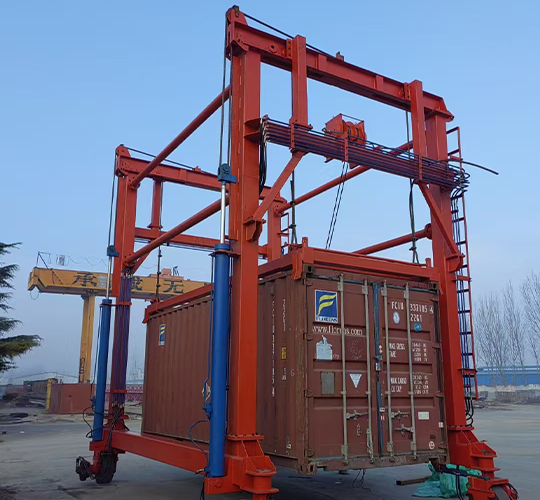
The primary goal of container handling machines is to move containers from one point to another safely and efficiently. Each type of machine has its unique working principles, but all share common elements that allow them to perform their tasks optimally:
All container handling machines use hydraulic or electric lift systems to raise and move containers. Gantry cranes use powerful winches to lift containers from ships, while reach stackers use telescopic arms and hydraulic systems to lift containers off the ground or stack them. Straddle carriers and forklifts also rely on hydraulic systems to lift containers and transport them across the yard.
The key to the efficiency of container handling machines is precision. The machines use advanced navigation and pathfinding technologies such as GPS, laser sensors, cameras, and radar to detect and avoid obstacles, plan safe routes, and follow pre-programmed pathways. Automated systems like AGVs are equipped with these technologies to ensure smooth operation in busy, congested environments.
Many modern container handling machines now incorporate automated systems that enable them to perform tasks with minimal human intervention. Automated cranes, AGVs, and other machines are often connected to central control systems that manage the flow of containers in the terminal, ensuring optimal route planning and task allocation. These systems can track the location of containers, manage yard operations, and integrate with larger supply chain management systems to provide real-time data on inventory, throughput, and equipment status.
Container handling technology has undergone significant advancements in recent years. These innovations are focused on improving the efficiency, safety, and environmental sustainability of port operations.
The trend toward automation is one of the most significant advancements in container handling. Automated cranes and AGVs have revolutionized terminal operations by eliminating much of the manual labor involved. Automated systems allow for more precise control, faster loading and unloading times, and fewer errors, all of which contribute to smoother terminal operations.
With the rise of the Internet of Things (IoT), many container handling machines are now equipped with sensors that monitor the health of the equipment in real time. These sensors send data to remote monitoring systems, which can predict when maintenance is needed, reducing downtime and avoiding costly repairs. Predictive maintenance helps operators proactively address potential issues before they disrupt operations.
Environmental sustainability has become a major focus for container handling equipment manufacturers. Many newer machines are powered by electric motors, reducing the carbon footprint of port operations. Additionally, emissions from diesel-powered machines are being minimized through improved engine efficiency and the adoption of hybrid technologies.
Container handling machines are vital to the efficiency of the global supply chain. Their ability to quickly and safely move large volumes of containers through ports and terminals directly impacts the speed at which goods are delivered. The faster and more efficiently containers can be moved, the more competitive and cost-effective the global supply chain becomes.
Moreover, the use of container handling machines reduces the reliance on human labor, mitigating the risk of errors and accidents, and improving safety in port environments. As shipping volumes continue to rise, the role of these machines in improving port productivity, reducing operational costs, and supporting global trade cannot be overstated.
Container handling machines are critical pieces of equipment that have transformed the logistics and shipping industries. Their ability to efficiently move, stack, and transport containers has revolutionized port operations, improved the speed of global trade, and reduced costs. As technology continues to advance, these machines will play an even more significant role in shaping the future of global supply chains. Automation, precision, and sustainability will remain key driving factors in the continued development and optimization of container handling machines. The future of container handling looks bright, with these machines continuing to evolve to meet the increasing demands of international commerce.
Contact: Ding Jinjun
Phone: 15966038337
Email: 15966038337@163.com
Address: Yangliu Industrial Park, Xintai City, Shandong Province
Central Asia, Southeast Asia, Middle East, South America, Africa
Shandong Longhui Crane Machinery Co., Ltd. was founded in 1992 and is a professional manufacturer of various types of lifting equipment with a registered capital of RMB 318 million. Mainly engaged in the design, manufacturing, installation, renovation, maintenance and other businesses of general bridge cranes, gantry cranes, metallurgical cranes, explosion-proof electric hoists, wire rope electric hoists, European Style Cranes and other products. The products involve 30 series and 6000 categories.
The company covers an area of 120000 square meters and currently has more than 1200 employees, including 32 middle and senior management personnel, 18 senior engineers, 106 intermediate engineers, and 272 engineering and technical personnel. It has more than ten functional departments including design, production, quality inspection, safety, etc., including electrical automation, raw materials, riveting and welding, assembly, heat treatment, machining, electric hoist, maintenance and other workshops. The company has 328 sets of advanced production equipment, more than 300 pieces of various testing instruments and measuring instruments, with good performance and effective calibration, and is a third level qualified measurement unit. The company has sales and service agencies in various provinces, cities, and other regions across the country, radiating to major power plants/steel mills, manufacturing enterprises, industrial and mining enterprises, ports and terminals, and cargo distribution centers.
Rated lifting capacity/rated lifting capacity:
Gn=5t, 10t, 16t, 20t,32t,50t,80t
Explosion proof grade/expansion proof class:
DIIBT4,DIICT4
Limit span:
7.5m<S<50m
Effective lifting height:
6m<H<30m
Lifting mechanism:
Electric hoist
Job level/workclass:
A4 level
Rated lifting capacity:
Gn=1t, 2t, 3t, 5t, 10t, 16t, 20t
Span span:
S7.5m-22m
Lifting mechanism/Lifting mechanism:
Electric hoist
Job level/work class:
A3, A5
Effectively lifting height Int;
H6m-30m
Rated lifting capacity/rated lifting capacity:
Gn=5, 10t, 16t, 20t,
Limit span:
7.5m≤S<50m
Job level/work class:
JC=25%, A3 level
Lifting mechanism/lifting mechanism:
Single electric hoist, dual electric hoist
Effective lifting height:
6m≤H<30m
Rated lifting capacity/rated lifting capacity:
Gn=5t, 10t, 16t, 20t
Limit span:
7.5m≤S<50m
Effective lifting height:
6m≤H<30m
Job level/workclass:
JC=25%, A3 level
Lifting mechanism/Lifting mechanism:
Electric hoist
xxxxxxxxx
Leave a messageThe company was established in 2013 and is an internet software technology enterprise with multiple independent intellectual property rights.

Copyright © 2022 Suzhou Xiangyun Platform Information Technology Co., Ltd
Site mapMain business area: Beijing Suzhou
This website uses cookies to ensure you get the best experience on our website.



 Phone
Phone
Comment
(0)