 中文
中文 Español
 Français
 العربية
SHANDONG LONGHUI GROUP CO., LTD.Shandong Longhui Crane Machinery
xxxxxxxxx
Leave a message
Tire-Type Container handling machines: Key to Efficient Port Operations
As the global supply chain grows increasingly complex, ports, container yards, and terminals face the challenge of handling massive volumes of cargo efficiently. In the context of containerized shipping, handling containers swiftly and safely is essential to maintaining throughput and minimizing delays. Tire-type container handling machines (TCMs) have become critical in the modern logistics landscape. These mobile, versatile machines have transformed how containers are moved, stacked, and organized in port and terminal operations. In this article, we will explore the features, types, working principles, advantages, and applications of tire-type container handling machines.
A tire-type container handling machine (TCM) is a heavy-duty vehicle used for lifting, transporting, and stacking containers in ports, warehouses, and container terminals. Unlike fixed equipment like gantry cranes or rail-mounted systems, tire-type machines are highly mobile due to their rubber tires. This flexibility allows them to operate on different surfaces such as asphalt, gravel, or concrete without the need for specialized tracks.
These machines are designed for high mobility and operational efficiency, equipped with hydraulic lifting systems and powerful engines to handle containers of varying sizes, typically ranging from 20 feet to 40 feet in length. Tire-type container handling machines are commonly used for short-distance movements, container stacking, and even for handling containers in areas with limited space or congested environments.
Tire-type container handling machines come in several forms, each suited to specific tasks and environments. The primary types include reach stackers, container handlers, forklifts, and tire-mounted gantry Cranes. Let's look at each type in more detail:
Reach stackers are one of the most common tire-type container handling machines. These machines feature a telescopic arm that allows them to extend and retract to pick up containers from various heights and distances. Reach stackers are used primarily for lifting and stacking containers in both horizontal and vertical directions.
Key Features of Reach Stackers:
Telescopic arm for lifting containers at different heights.
Maneuverability in narrow spaces, making them ideal for smaller terminals.
Versatility in handling containers of various sizes (20ft, 40ft, or even larger).
High lifting capacity and flexibility in container movement.
Container handlers are designed for high-density container stacking. These machines have robust lifting mechanisms and are often used in terminals with large volumes of containers. They are equipped with spreaders to ensure precise placement of containers in stacking systems.
Key Features of Container Handlers:
Strong lifting capacity to handle heavy loads.
Designed for stacking containers in multi-tier systems.
Effective for moving both loaded and empty containers.
High efficiency in large terminals with dense container storage.
Forklifts are versatile machines used in smaller terminal environments or for handling containers in warehouses. These vehicles are typically employed for shorter distances and are ideal for moving containers in confined spaces. Forklifts may be equipped with specialized attachments such as spreaders or forks to handle containers effectively.
Key Features of Forklifts:
Compact design for maneuvering in tight spaces.
Quick and efficient in moving containers short distances.
Ideal for smaller operations or specific tasks within a terminal.
Can be equipped with various attachments to handle different container sizes.
Tire-mounted gantry cranes combine the attributes of gantry cranes with tire-based mobility. These machines can cover large distances within a container yard and are often used for intermodal operations. Tire-mounted gantry cranes are commonly found in ports and large terminals where containers need to be moved across substantial areas.
Key Features of Tire-Mounted Gantry Cranes:
Can handle high-volume container stacking and transportation.
Excellent for moving containers between different modes of transport, such as trucks and rail.
Capable of operating in long, linear areas where space allows for extended travel.
Tire-type container handling machines rely on advanced hydraulic systems, sensors, and control mechanisms to perform their tasks efficiently. The machines are designed for heavy-duty container handling operations and typically include the following core functions:
The primary advantage of tire-type machines is their mobility. These machines are equipped with heavy-duty rubber tires that enable them to move freely across various terrains, such as gravel, asphalt, or concrete. Depending on the machine, they may feature different steering systems, including:
Front-wheel steering for enhanced maneuverability in tight spaces.
All-wheel steering for greater control when moving large distances or around obstacles.
Crab steering to help move the machine diagonally, which improves its ability to maneuver in cramped environments.
These steering systems allow tire-type container handling machines to adapt to diverse working environments, whether it’s a crowded terminal or a remote storage facility.
Tire-type container handling machines are equipped with hydraulic systems that power their lifting arms or spreaders. These hydraulic systems are designed to handle heavy loads, ensuring that containers are lifted, moved, and placed with precision. The lifting mechanisms are operated by a combination of sensors, hydraulic pumps, and control units to ensure the machine functions efficiently.
In reach stackers, the telescoping arm allows for stacking containers in high or narrow spaces, while in container handlers, a spreader attachment facilitates the lifting and lowering of containers.
Safety is a top priority in container handling, given the massive weight of the containers and the risk of accidents. To ensure the safe operation of tire-type machines, many machines come equipped with various safety features:
Load sensors to prevent lifting containers that exceed the machine’s weight limit.
Stability control systems to ensure the machine remains balanced during lifting operations.
Obstacle detection systems (such as cameras or radar) that alert the operator to any potential hazards in the machine’s path.
Emergency stop systems to quickly halt the machine in case of malfunction or operator error.
These features are essential for minimizing risks and ensuring safe operations in busy terminal environments.
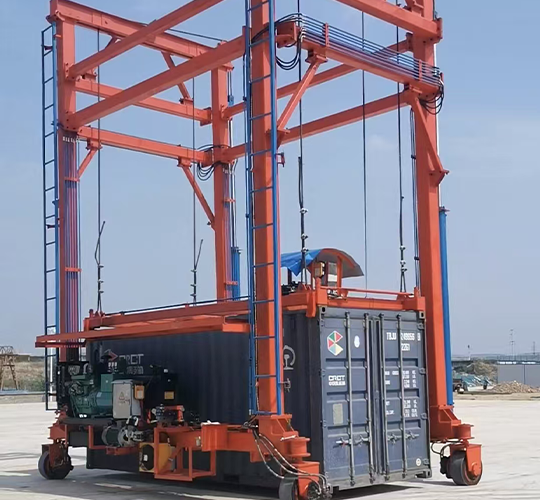
Tire-type container handling machines provide several benefits that make them the preferred choice in modern logistics and port operations.
One of the biggest advantages of tire-type machines is their flexibility. They can operate on various surfaces, including concrete, asphalt, and even dirt, making them suitable for use in different types of environments. Whether in a busy port or a more rural terminal, these machines can move freely, handling containers without the need for specialized infrastructure.
Tire-type container handling machines are a cost-effective solution for container handling. Unlike rail-mounted or gantry cranes, tire-type machines don’t require expensive track systems or fixed infrastructure. This reduces capital investment and operational costs, particularly for smaller terminals or warehouses that don’t need large-scale, fixed infrastructure.
The mobility and flexibility of tire-type machines lead to increased efficiency in port operations. These machines can quickly move between different areas of a terminal, facilitating the rapid transfer of containers from one location to another. This mobility reduces downtime and increases throughput, helping to move containers faster and more efficiently.
Because tire-type container handling machines are largely automated, they reduce the need for manual labor. The machines can operate autonomously, and when used in conjunction with automated systems, they can complete container movements without the need for human intervention. This leads to significant savings in labor costs and increases overall efficiency.
With built-in safety systems such as load sensors, stability controls, and obstacle detection, tire-type container handling machines are safer to operate compared to traditional manual container handling methods. These safety features help prevent accidents and reduce the risk of injuries in busy terminal environments.
Tire-type container handling machines are used in a variety of applications across different sectors of logistics and transportation:
Tire-type machines are commonly used in ports for the handling of containers. They are ideal for tasks such as loading and unloading containers from ships, moving containers between different areas of the terminal, and stacking containers for storage. Their ability to move freely within the port area makes them highly versatile and efficient.
In intermodal terminals, where containers are transferred between ships, trucks, and rail, tire-type machines play a crucial role in ensuring smooth and efficient operations. These machines facilitate the transfer of containers between different modes of transport, reducing delays and improving supply chain efficiency.
Tire-type machines are used in warehouses and distribution centers to move containers between storage areas. These machines are especially beneficial in environments where space is limited and containers need to be quickly and safely handled without causing congestion.
Tire-type container handling machines are also used in construction and mining operations to move heavy materials, equipment, and containers. Their flexibility allows them to navigate rough terrains, making them suitable for use in these challenging environments.
The future of tire-type container handling machines is closely linked to advances in automation, electric propulsion, and data analytics. Some of the key trends to look for include:
The growing trend toward automation in ports is expected to drive the development of autonomous tire-type container handling machines. These machines will be equipped with advanced sensors, machine learning algorithms, and real-time data processing systems to enable them to operate without human intervention.
As the push for sustainability increases, electric-powered tire-type machines are likely to become more prevalent. These machines will offer environmental benefits, including reduced emissions and lower operating costs compared to diesel-powered models.
The integration of tire-type machines with smart port systems will enable real-time tracking, predictive maintenance, and optimized scheduling. By incorporating technologies like the Internet of Things (IoT) and cloud-based systems, tire-type machines will become more efficient, reducing downtime and maximizing terminal throughput.
Tire-type container handling machines are indispensable tools in modern port operations. Their mobility, flexibility, and efficiency make them ideal for a wide range of applications, from container stacking to intermodal transfers. With advancements in automation, electrification, and smart technologies, these machines will continue to evolve, playing an increasingly central role in the logistics and transportation industries. As ports and terminals seek to improve efficiency, reduce costs, and enhance safety, tire-type container handling machines will remain a critical element of the global supply chain.
Contact: Ding Jinjun
Phone: 15966038337
Email: 15966038337@163.com
Address: Yangliu Industrial Park, Xintai City, Shandong Province
Central Asia, Southeast Asia, Middle East, South America, Africa
Shandong Longhui Crane Machinery Co., Ltd. was founded in 1992 and is a professional manufacturer of various types of lifting equipment with a registered capital of RMB 318 million. Mainly engaged in the design, manufacturing, installation, renovation, maintenance and other businesses of general bridge cranes, gantry cranes, metallurgical cranes, explosion-proof electric hoists, wire rope electric hoists, European Style Cranes and other products. The products involve 30 series and 6000 categories.
The company covers an area of 120000 square meters and currently has more than 1200 employees, including 32 middle and senior management personnel, 18 senior engineers, 106 intermediate engineers, and 272 engineering and technical personnel. It has more than ten functional departments including design, production, quality inspection, safety, etc., including electrical automation, raw materials, riveting and welding, assembly, heat treatment, machining, electric hoist, maintenance and other workshops. The company has 328 sets of advanced production equipment, more than 300 pieces of various testing instruments and measuring instruments, with good performance and effective calibration, and is a third level qualified measurement unit. The company has sales and service agencies in various provinces, cities, and other regions across the country, radiating to major power plants/steel mills, manufacturing enterprises, industrial and mining enterprises, ports and terminals, and cargo distribution centers.
Rated lifting capacity/rated lifting capacity:
Gn=5t, 10t, 16t,20t
Limit span: 7.5m ≤ S ≤ 50m
Effective lifting height: 6m ≤ H<30m
Job level/work class:
A7 level, A8 level
Rated lifting capacity/rated lifting capacity:
Gn=3t, 5t, 10t, 12.5t, 16t,20t
Limit span/limitspan:
7.5m≤s<50m
Effective lifting height:
6m≤H<30m
You can choose European electric hoist brands:
DemagCranes,
Koni SWF, Novotranes Crane
Job level/work class:
A4 level
Lifting mechanism/lifting mechanism: electric hoist
Rated lifting capacity/rated lifting capacity: Gn=32t,41t, 50t,60t
Limit span:
7.5msS<50m
Effective lifting height: 6 m ≤ H<30m
Job level/work class:
JC=50%, A5 level JC=60%, A6 level
gantry cranes, widely used in various industries for their efficiency and versatility, are not without common issues that can affect their performance and safety. Regular maintenance and inspection are crucial to address these problems promptly.
Track Problems: Wear, misalignment, or inadequate lubrication of the tracks can lead to increased friction and potential derailment. Regular checks should ensure proper alignment, lubrication, and absence of cracks or defects.
Wheels and Bearings: Worn-out wheels or bearings may cause vibrations and reduce operational stability. Inspections should focus on wheel wear, proper lubrication, and secure mounting.
Girder Deformation: Overloading or fatigue can deform the Crane girder, affecting its load-bearing capacity. Visual inspections and measurements help identify any deviations from standard tolerances.
Loose Bolts and Welds: Loose connection bolts or defective welds compromise structural integrity. Regular tightening and non-destructive testing (NDT) of critical joints are essential.
Brake System Failure: Malfunctioning brakes can result in uncontrolled movements. Checks should include brake lining wear, hydraulic system leaks, and response time tests.
Steel Wire Rope Deterioration: Frayed, corroded, or kinked wire ropes pose significant risks. Regular visual inspections and rope tension checks help prevent failures.
Electrical System Faults: Damaged cables or faulty connections can lead to electrical failures. Inspections should cover cable condition, connector tightness, and grounding reliability.
Hook and Sheave Damage: Cracks or deformation in hooks and sheaves can cause load drops. Periodic examinations using dye penetrant testing or magnetic particle inspection are necessary.
Lubrication Deficiencies: Inadequate lubrication increases wear and tear. A scheduled lubrication program targeting all moving parts is vital for smooth operation.
To mitigate these issues, a comprehensive maintenance plan should be implemented:
Daily Checks: Focus on critical components like brakes, hooks, and limit switches to ensure immediate readiness and safety.
Periodic Inspections: Conduct detailed examinations at regular intervals (e.g., monthly or annually) to assess structural integrity, wire rope condition, and electrical systems.
Preventive Measures: Address minor issues before they escalate into major problems through timely repairs and part replacements.
By proactively identifying and resolving these common issues, gantry crane operators can enhance equipment reliability, extend service life, and maintain a safe working environment.
xxxxxxxxx
Leave a messageThe company was established in 2013 and is an internet software technology enterprise with multiple independent intellectual property rights.

Copyright © 2022 Suzhou Xiangyun Platform Information Technology Co., Ltd
Site mapMain business area: Beijing Suzhou
This website uses cookies to ensure you get the best experience on our website.



 Phone
Phone
Comment
(0)