 中文
 Español
 Français
 العربية
SHANDONG LONGHUI GROUP CO., LTD.Shandong Longhui Crane Machinery
xxxxxxxxx
Leave a message
Portal Crane Product Introduction
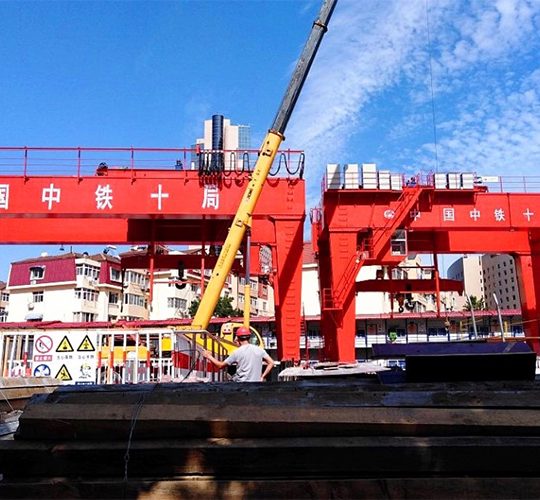
A Portal Crane, also known as a Portal Lifting Crane or gantry crane (in some contexts), is a type of crane that features a bridge supported by legs, which run on tracks or rails at ground level. These cranes are designed to lift and move heavy loads within a large area, either indoors or outdoors, and are often used in industries such as construction, shipping, and manufacturing. The portal crane is known for its stability, high lifting capacity, and ability to operate in open spaces where overhead cranes might not be feasible.
Key Features:
Sturdy Design:
The portal crane consists of a robust frame with two or more legs supported by a rail system. These legs ensure stability and allow the crane to span large distances, making it ideal for applications requiring heavy lifting in large, open spaces.
Freestanding Structure:
Unlike overhead cranes, which rely on fixed structures, the portal crane is freestanding. This allows it to be used in locations without needing any overhead structural support, making it suitable for construction sites, ports, and outdoor facilities.
Large Span:
Portal cranes can cover wide spans, which makes them effective for lifting large loads over a broad area. This feature is particularly valuable in industries such as shipbuilding, construction, and container handling at ports.
Adjustable Lifting Height:
The lifting height of a portal crane can be adjusted according to the operational requirements. This flexibility is useful when handling various materials or components with different size and height specifications.
Heavy Load Capacity:
Portal cranes are known for their high load capacities, ranging from several tons to hundreds of tons, depending on the model. They are suitable for moving extremely heavy and oversized items, such as heavy machinery, construction materials, or containers.
Versatility:
These cranes are available in various configurations, including single-girder and double-girder designs, each providing varying load capacities and operational capabilities. Double-girder portal cranes offer enhanced strength for heavy-duty applications, while single-girder systems are more economical for lighter tasks.
Outdoor and Indoor Use:
Portal cranes are used in both outdoor and indoor environments. They are commonly found in open-air facilities like ports and construction sites, but can also be used in factories and warehouses with high ceilings or spacious production areas.
Mobility:
Some portal cranes are equipped with wheels or tracks, making them mobile. This mobility allows the crane to be relocated within the facility or across a worksite to address different lifting needs.
Applications:
Construction:
Used to move heavy construction materials such as steel beams, concrete panels, and prefabricated parts across large construction sites.
Shipbuilding:
Portal cranes are essential in shipyards for lifting and positioning large ship sections, moving heavy machinery, and assembling vessels.
Ports and Shipping Yards:
In ports, container portal cranes are used for unloading and loading containers from ships onto trucks or trains. Their large span allows them to handle containers efficiently.
Manufacturing and Assembly:
In factories, portal cranes are used to lift and transport heavy materials, components, and machinery within the production area. They are especially useful in automotive manufacturing, steel production, and heavy equipment assembly.
Warehouse Operations:
Portal cranes help in warehouses that require the movement of large, heavy items over long distances. They are often used to move bulk materials or machinery across the floor space.
Specifications:
Load Capacity: Portal cranes can handle a wide range of loads, typically from 1 ton to 500 tons or more. Heavy-duty portal cranes used in shipbuilding or construction may have higher capacities.
Span: The span of a portal crane can be customized to suit the specific needs of the operation, typically ranging from a few meters to several dozen meters.
Lifting Height: Adjustable based on the operational requirements, with cranes often designed to handle a range of lifting heights from a few meters to several tens of meters.
Speed: Lifting speed and trolley movement speed can be adjusted according to the needs of the operation. Portal cranes typically offer precise control to handle delicate or large loads safely.
Power Source: Portal cranes are usually powered by electric motors for both trolley and hoist movement. In outdoor or remote environments, some portal cranes are powered by diesel engines.
Advantages:
High Stability and Capacity:
The robust design and large base of portal cranes ensure excellent stability, even when lifting heavy loads. This makes them suitable for heavy-duty applications, including construction and shipbuilding.
Flexibility:
Portal cranes can be customized to meet specific lifting and operational needs. They can handle a wide variety of materials and loads of varying sizes and weights, making them versatile in different industries.
Cost-Effective for Outdoor Applications:
Since portal cranes do not require overhead structures, they are a cost-effective solution for outdoor applications where traditional overhead cranes may not be feasible.
Efficient for Large Areas:
The large span and mobility of portal cranes make them ideal for lifting and transporting materials across large areas, such as construction sites, port terminals, or manufacturing plants.
Easy to Operate:
Portal cranes are typically equipped with user-friendly control systems, including pendant controls, radio controls, or remote control options. This ensures smooth and efficient operation for the crane operators.
Maintenance and Safety Considerations:
Routine Inspections: Regular inspection of the crane’s structural components, hoist mechanism, rails, and safety systems is necessary to maintain safe operation.
Lubrication: Proper lubrication of moving parts, including the trolley and hoist system, is crucial for reducing wear and preventing breakdowns.
Safety Systems: Ensure that safety features like overload protection, emergency stops, limit switches, and safety brakes are functioning properly. These systems prevent accidents and ensure the safe handling of heavy loads.
Conclusion:
The Portal Crane is a versatile, heavy-duty lifting solution ideal for applications that require large spans and the ability to lift and transport heavy loads. With their high load capacity, adjustable lifting height, and robust design, portal cranes are widely used in industries such as construction, shipbuilding, and port operations. Their ability to operate in both indoor and outdoor environments, along with their cost-effectiveness and flexibility, makes them a popular choice for heavy material handling tasks.
Frequently Asked Questions (FAQ) about Portal Cranes
What is a Portal Crane?
A Portal Crane is a type of crane with a bridge supported by legs that run on tracks or rails. It is used to lift and move heavy loads over large areas. Unlike traditional overhead cranes, portal cranes are freestanding and do not rely on overhead structures, making them ideal for outdoor and open-air applications.
What industries use Portal Cranes?
Construction: For moving heavy construction materials such as steel beams, concrete slabs, and prefabricated structures.
Shipbuilding: In shipyards for lifting and positioning large ship sections or machinery.
Ports and Shipping: For unloading and loading containers at port terminals.
Manufacturing: In factories and assembly lines to move heavy components or machinery.
Warehousing: To move large or heavy goods within warehouses or storage areas.
Portal cranes are commonly used in industries like:
What are the different types of Portal Cranes?
Single-Girder Portal Crane: A more cost-effective option for lighter loads, with a single girder spanning across the legs.
Double-Girder Portal Crane: A more robust system designed for heavier lifting capacities, with two parallel girders for added strength.
Mobile Portal Crane: Equipped with wheels or tracks, allowing it to move across different locations, often used for temporary setups or in large outdoor spaces.
Fixed Portal Crane: Stationary, typically used in permanent installations, such as shipyards, ports, or large factories.
What is the typical load capacity of a Portal Crane?
Portal cranes can handle a wide range of load capacities, from as little as 1 ton to over 500 tons, depending on the application and crane specifications. Heavy-duty models for shipbuilding and large construction projects may have even higher capacities.
How does a Portal Crane work?
A portal crane operates by moving along a set of rails or tracks using a hoist mechanism on the bridge. The hoist lifts the load vertically, while the bridge or trolley moves horizontally to position the load as needed. This combination of vertical and horizontal movement allows the crane to place or transport heavy loads across large areas.
Can a Portal Crane be used outdoors?
Yes, portal cranes are often used outdoors. Their design makes them well-suited for construction sites, shipyards, port terminals, and other open-air environments. Outdoor models are typically built to withstand the elements and may be powered by electric motors or diesel engines, depending on the location.
What are the main advantages of a Portal Crane?
Flexibility: Portal cranes can cover large areas and can be either fixed or mobile depending on the requirements.
High Load Capacity: They are designed to handle heavy loads, making them ideal for lifting large or bulky materials.
Cost-Effective: Since portal cranes do not require overhead structural support, they can be a more cost-effective solution than traditional overhead cranes.
Wide Span: The large span of portal cranes allows for lifting materials over a wide area, which is especially useful in industries like shipbuilding and container handling.
Durability: Built to be durable and capable of handling harsh environments, portal cranes are often used in tough industrial settings.
Shandong Longhui Crane Machinery Co., Ltd. was founded in 1992 and is a professional manufacturer of various types of lifting equipment with a registered capital of RMB 318 million. Mainly engaged in the design, manufacturing, installation, renovation, maintenance and other businesses of general bridge cranes, gantry cranes, metallurgical cranes, explosion-proof electric hoists, wire rope electric hoists, European Style Cranes and other products. The products involve 30 series and 6000 categories.
The company covers an area of 120000 square meters and currently has more than 1200 employees, including 32 middle and senior management personnel, 18 senior engineers, 106 intermediate engineers, and 272 engineering and technical personnel. It has more than ten functional departments including design, production, quality inspection, safety, etc., including electrical automation, raw materials, riveting and welding, assembly, heat treatment, machining, electric hoist, maintenance and other workshops. The company has 328 sets of advanced production equipment, more than 300 pieces of various testing instruments and measuring instruments, with good performance and effective calibration, and is a third level qualified measurement unit. The company has sales and service agencies in various provinces, cities, and other regions across the country, radiating to major power plants/steel mills, manufacturing enterprises, industrial and mining enterprises, ports and terminals, and cargo distribution centers.
Rated lifting capacity/rated lifting capacity:
Gn=3t, 5t, 10t, 12.5t, 16t,20t
Limit span/limitspan:
7.5m≤s<50m
Effective lifting height:
6m≤H<30m
You can choose European electric hoist brands:
DemagCranes,
Koni SWF, Novotranes Crane
Job level/work class:
A4 level
Lifting mechanism/lifting mechanism: electric hoist
Rated lifting capacity/rated lifting capacity:
Gn=5t, 10t, 16t, 20t
Limit span:
7.5m≤S<50m
Effective lifting height:
6m≤H<30m
Job level/workclass:
JC=25%, A3 level
Lifting mechanism/Lifting mechanism:
Electric hoist
Rated lifting capacity/rated lifting capacity:
Gn=50t, 80t, 100t, 125t,
150t,200t
Limit span:
7.5m<S<50m
Effective lifting height:
6m≤H≤30m
Job level/work class:
A3 level
Rated lifting capacity/rated lifting capacity:
Gn=5t, 10t, 16t, 20t, 32t,
50t, 75t, 100t, 125t, 150t, 200t,
300t, 320t
Limit span:
7.5m≤S<50m
Effective lifting height: 6m ≤ H ≤ 30m
Lifting mechanism: Winch sy stem winch system
Structural form/structure type:
Box type double main beam with double legs on both sides
girder double side double leg
Job level/work class: JC=50%, JC=60% A5 level A6 level
Rated lifting capacity/rated lifting capacity: Gn=32t,41t, 50t,60t
Limit span:
7.5msS<50m
Effective lifting height: 6 m ≤ H<30m
Job level/work class:
JC=50%, A5 level JC=60%, A6 level
gantry cranes, also known as Portal Cranes or gantry hoists, are bridge-type lifting devices that operate on ground tracks. They are widely used in open-air stockyards, warehouse docks, power stations, and shipyards. By supporting the bridge with two legs on either side, these Cranes use electric hoists or hooks to lift and horizontally transport heavy loads, making them an essential tool for achieving mechanization and automation in industrial production.
The main components of a gantry crane include the bridge, large vehicle running mechanism, small vehicle running mechanism, and electrical control system. Its working principle involves the movement of an electric hoist or hook along the main beam while the entire device can move longitudinally along tracks on the ground. This design allows gantry cranes to have a wide coverage area and flexible operation capabilities, making them particularly suitable for occasions where frequent handling of heavy objects is required.
Due to their high efficiency and adaptability, gantry cranes play significant roles across various industries:
Equipment Manufacturing: Used for assembling and transporting large mechanical parts.
Energy and Power: Responsible for lifting heavy equipment during power station construction.
Transportation and Logistics: Employed at ports and railway yards for container loading and unloading.
Automobile and Shipbuilding: Assisting in material handling and assembly on production lines.
Metallurgy and Building Materials: Handling high-temperature or special materials during transportation.
Light Industry: Such as raw material and finished product handling in papermaking industries.
In recent years, China's annual output of gantry cranes has remained stable at around 40,000 to 50,000 units, basically meeting domestic market demand and exporting heavily to international markets. With rapid development and technological upgrades in downstream industries, performance requirements for mid-to-high-end products continue to rise, driving advancements within the industry itself.
Currently, the domestic market exhibits intense competition among numerous players; multinational corporations dominate the mid-to-high-end segment through advanced technologies, whereas domestic enterprises secure market share in specific areas by leveraging cost advantages. Looking ahead, enhancing independent research and development capabilities for core components will be crucial for strengthening global competitiveness.
Overall, under trends towards intelligence and greenification, the gantry crane industry faces broader prospects for growth, providing robust support for modernization efforts across diverse sectors.
xxxxxxxxx
Leave a messageThe company was established in 2013 and is an internet software technology enterprise with multiple independent intellectual property rights.

Copyright © 2022 Suzhou Xiangyun Platform Information Technology Co., Ltd
Site mapMain business area: Beijing Suzhou
This website uses cookies to ensure you get the best experience on our website.



 Phone
Comment
(0)