 中文
中文 Español
 Français
 العربية
SHANDONG LONGHUI GROUP CO., LTD.Shandong Longhui Crane Machinery
xxxxxxxxx
Leave a message
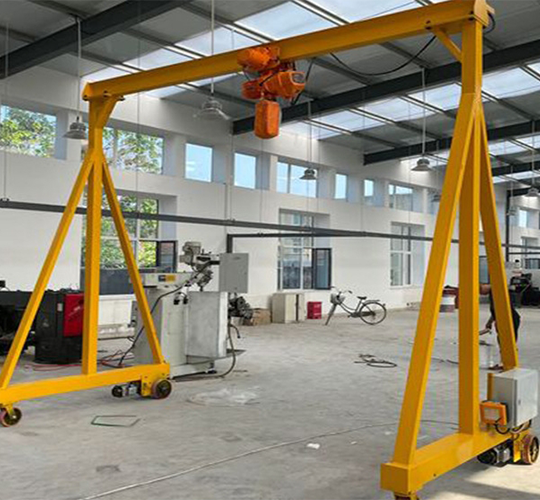
Straight-Line Gantry Frame Product Introduction
A Straight-Line Gantry Frame is a type of gantry crane with a frame design that moves along a straight path, supported by legs running on rails or tracks. This Crane system is designed to transport and lift heavy loads in a linear direction with high precision and stability. The straight-line design makes it ideal for applications where long, uninterrupted movement along a fixed path is required.
Key Features:
Straight-Line Movement:
The straight-line gantry frame is specifically engineered to move loads along a predetermined, linear path. This makes it highly suitable for environments where precision and consistent travel in a straight direction are crucial.
Heavy Load Capacity:
Straight-line gantry frames are designed to handle a wide range of heavy loads, from a few tons to several hundred tons, depending on the crane’s specifications. This makes them suitable for industries such as shipbuilding, steel production, and large-scale construction projects.
Stable and Reliable Design:
The structure of the straight-line gantry frame is designed for maximum stability, ensuring that heavy loads are moved securely and efficiently. The legs of the gantry frame run on sturdy tracks, minimizing the risk of tipping and ensuring smooth operation even under heavy loads.
Simple and Efficient Operation:
Straight-line gantry frames are equipped with a hoist system, which moves loads vertically, and a trolley, which moves the hoist along the straight path. The operation is controlled through manual or electric systems, providing flexibility and ease of use for operators.
Versatile Application:
This type of gantry crane is versatile and can be adapted to a wide range of industrial environments. It is commonly used in applications where large or heavy materials need to be moved over long, straight distances, such as in construction, steel manufacturing, or shipbuilding.
Customizable Design:
Straight-line gantry frames can be customized according to specific needs. Adjustments can be made to the load capacity, span, lifting height, and mobility features, ensuring that the crane suits the requirements of the application.
Applications:
Construction Sites:
The straight-line gantry frame is widely used in construction to lift and move large construction materials such as steel beams, concrete panels, and heavy machinery. Its design allows it to travel across large areas and deliver materials exactly where they are needed.
Shipbuilding and Heavy Industry:
In shipyards and heavy industries, the straight-line gantry frame is ideal for transporting heavy equipment or ship sections. The crane’s high load capacity and straight-line movement make it perfect for assembling or moving large-scale structures.
Steel and Metal Manufacturing:
The gantry frame is commonly used in steel mills or metal production facilities to move steel billets, ingots, or coils. Its precision and stability are important in environments where materials are heavy and must be moved without damage.
Warehousing and Storage:
In large storage facilities or warehouses, straight-line gantry frames are used for moving heavy goods or raw materials over long distances. Their ability to cover large areas with straight-line motion makes them an excellent solution for bulk material handling.
Transporting Large Equipment:
Straight-line gantry frames are effective for moving large machinery and equipment in manufacturing facilities or construction sites. The stable movement along a straight path ensures that the equipment is moved securely.
Specifications:
Load Capacity: Typically ranges from 1 ton to 500 tons or more, depending on the design. High-capacity models are used for heavy-duty tasks, while lighter models are used for smaller materials.
Span: The span of a straight-line gantry frame can be customized to suit the work environment. It can range from a few meters for smaller applications to several dozen meters for larger operations.
Lifting Height: The height at which the crane can lift loads is adjustable to meet specific needs. It typically ranges from a few meters to over 50 meters in some heavy-duty models.
Traveling Speed: The crane’s travel speed can vary, depending on the application. Typically, speeds range from 5 m/min to 100 m/min or higher for faster operations.
Power Source: Can be powered by electric motors, diesel engines, or hybrid systems. Electric models are commonly used for indoor operations, while diesel-powered units are better suited for outdoor environments or areas without access to electrical power.
Advantages:
Precision and Stability:
The straight-line movement provides precise control over load positioning and ensures that the crane remains stable, even when handling heavy loads. This reduces the risk of accidents and increases the safety of operations.
Large Coverage Area:
The gantry frame's ability to travel over large distances in a straight line allows it to cover expansive areas such as construction sites, shipyards, or factories with ease.
Efficient Operation:
Straight-line gantry frames are simple to operate and require minimal maintenance. They provide efficient handling of materials, reducing the time and labor needed to move heavy loads.
Durability:
Built from strong, durable materials, these cranes are designed to withstand heavy use in demanding environments, offering long-lasting performance with minimal downtime.
Cost-Effective:
Since they do not require an overhead building structure, straight-line gantry frames are a cost-effective lifting solution for large areas, making them more affordable than overhead cranes in certain applications.
Versatility:
These cranes can be used in a wide variety of industries and are adaptable to different types of loads and work environments. They can be tailored to meet the specific needs of the application.
Maintenance and Safety Considerations:
Regular Inspection: Inspect the gantry frame’s structure, tracks, hoist, and electrical components regularly to identify signs of wear or damage.
Lubrication: Moving parts, such as the hoist, trolley, and wheels, should be properly lubricated to reduce friction and ensure smooth operation.
Testing Safety Features: Check safety systems like overload protection, limit switches, and emergency stop buttons to ensure they are working correctly.
Monitoring Load Capacity: Ensure that the load does not exceed the crane’s rated capacity, as this could cause damage or failure.
Conclusion:
A Straight-Line Gantry Frame is a reliable, efficient, and cost-effective lifting solution for industries that require the transportation of heavy loads across long distances. Its straight-line movement offers precision and stability, while its versatility allows it to be used in various applications, including construction, shipbuilding, manufacturing, and warehousing. With customizable specifications, high load capacities, and a durable design, this crane is an essential tool for handling large-scale lifting tasks in industrial environments.
Frequently Asked Questions (FAQ) about Straight-Line Gantry Frame
What is a Straight-Line Gantry Frame?
A Straight-Line Gantry Frame is a type of crane designed to move along a fixed, linear path, supported by legs that run on tracks or rails. It is used for lifting and transporting heavy loads over long, straight distances in industrial environments, offering precise movement and stability.
What are the key advantages of using a Straight-Line Gantry Frame?
Precision and Stability: It moves loads along a straight path, ensuring precise control and reducing the risk of instability.
Large Coverage Area: Ideal for covering expansive areas, such as construction sites, shipyards, or factories, with consistent linear movement.
Cost-Effective: Since it doesn’t require overhead structural support, it’s a more affordable alternative to overhead cranes in certain applications.
High Load Capacity: Straight-line gantry frames can handle heavy loads, making them suitable for industries like shipbuilding, steel manufacturing, and large construction projects.
What are the typical applications for a Straight-Line Gantry Frame?
Construction: Moving large construction materials like steel beams, concrete panels, and heavy machinery across sites.
Shipbuilding: Lifting and transporting large ship sections or heavy equipment in shipyards.
Manufacturing: Moving bulky products or raw materials in factories, steel mills, or metalworking industries.
Warehousing: Handling large goods or equipment across storage areas or warehouses.
What load capacity can a Straight-Line Gantry Frame handle?
Straight-line gantry frames can typically lift loads ranging from 1 ton to over 500 tons, depending on the design and specifications. The capacity is determined by the crane’s structure, hoisting system, and motor power.
What is the span of a Straight-Line Gantry Frame?
The span can vary based on the specific application, but it typically ranges from a few meters for smaller setups to several dozen meters for larger, heavy-duty operations. The span refers to the width of the crane between the two legs.
What is the height at which a Straight-Line Gantry Frame can lift?
The lifting height depends on the specific model and application. Typically, it can range from a few meters to over 50 meters for heavy-duty applications, allowing it to lift and place materials at varying heights based on the need.
How fast can a Straight-Line Gantry Frame move?
The speed of the crane's movement depends on the design and load it is handling. Travel speeds typically range from 5 meters per minute for slow, precise movements to 100 meters per minute for faster operations in high-demand environments.
What is the power source for a Straight-Line Gantry Frame?
Electric-powered: Most straight-line gantry frames are powered by electric motors, ideal for indoor or enclosed spaces.
Diesel-powered: For outdoor use or areas without electrical infrastructure, diesel-powered models are more common.
Hybrid models: Some cranes feature hybrid systems combining electric and diesel power for greater flexibility in various environments.
What are the safety features of a Straight-Line Gantry Frame?
Overload Protection: Prevents the crane from lifting loads beyond its rated capacity, reducing the risk of accidents.
Limit Switches: Ensure the crane does not move beyond its safe operational range.
Emergency Stop Button: Allows operators to stop the crane immediately in case of an emergency.
Anti-collision Systems: Protects the crane from colliding with obstacles or other machines.
Braking Systems: Ensures the crane stops safely during power failures or other emergencies.
These FAQs provide essential information about straight-line gantry frames, addressing their functions, specifications, safety, maintenance, and common applications. By understanding these factors, you can make an informed decision when selecting and operating a straight-line gantry frame in various industrial settings.
Shandong Longhui Crane Machinery Co., Ltd. was founded in 1992 and is a professional manufacturer of various types of lifting equipment with a registered capital of RMB 318 million. Mainly engaged in the design, manufacturing, installation, renovation, maintenance and other businesses of general bridge cranes, gantry cranes, metallurgical cranes, explosion-proof electric hoists, wire rope electric hoists, European Style Cranes and other products. The products involve 30 series and 6000 categories.
The company covers an area of 120000 square meters and currently has more than 1200 employees, including 32 middle and senior management personnel, 18 senior engineers, 106 intermediate engineers, and 272 engineering and technical personnel. It has more than ten functional departments including design, production, quality inspection, safety, etc., including electrical automation, raw materials, riveting and welding, assembly, heat treatment, machining, electric hoist, maintenance and other workshops. The company has 328 sets of advanced production equipment, more than 300 pieces of various testing instruments and measuring instruments, with good performance and effective calibration, and is a third level qualified measurement unit. The company has sales and service agencies in various provinces, cities, and other regions across the country, radiating to major power plants/steel mills, manufacturing enterprises, industrial and mining enterprises, ports and terminals, and cargo distribution centers.
Rated lifting capacity:
Gn=1t, 2t, 3t, 5t, 10t, 16t, 20t
Span span:
S7.5m-22m
Lifting mechanism/Lifting mechanism:
Electric hoist
Job level/work class:
A3, A5
Effectively lifting height Int;
H6m-30m
Rated lifting capacity/rated lifting capacity:
Gn=5t, 10t, 16t, 20t,
32t(5+5t,10+10t16+16t,20+20t)
Limit span: 7.5m<S<50m
Effective lifting height:
6m<H<30m
Structure type:
Box type, truss type
Job level/work class:
JC=25%, A3 level
Lifting mechanism/lifting mechanism:
Single electric hoist, dual electric hoist
Rated lifting capacity/rated lifting capacity:
Gn=5, 10t, 16t, 20t,
Limit span:
7.5m≤S<50m
Job level/work class:
JC=25%, A3 level
Lifting mechanism/lifting mechanism:
Single electric hoist, dual electric hoist
Effective lifting height:
6m≤H<30m
Rated lifting capacity/rated lifting capacity:
Gn=5t, 10t, 16t, 20t
Limit span:
7.5msSs50m
Effective lifting height:
6msH≤30m
Job level/work class:
A6 level
Rated lifting capacity/rated lifting capacity: Gn=32t,41t, 50t,60t
Limit span:
7.5msS<50m
Effective lifting height: 6 m ≤ H<30m
Job level/work class:
JC=50%, A5 level JC=60%, A6 level
In modern construction and manufacturing industries, Cranes play a vital role. As heavy machinery designed for lifting, hoisting, and transporting objects, cranes significantly enhance work efficiency, reduce manual labor intensity, and ensure the safety and quality of engineering projects. Whether on construction sites or in large manufacturing facilities, cranes provide reliable support for completing complex tasks.
1. Basic Structure and Working Principle of Cranes
Cranes typically consist of several key components, including the boom, hook, winch, motor, and control system. The boom, the primary structure, supports or suspends the load. The winch, powered by the motor, provides the force to lift the load. The control system enables precise operation of the entire lifting process. Cranes operate based on the lever principle, moving objects vertically by adjusting the load’s center of gravity.
2. Applications of Cranes in Construction
In the construction industry, cranes are indispensable. They are essential for handling heavy materials such as steel beams, concrete blocks, bricks, and prefabricated components. Key applications include:
Material Lifting and Transport: Cranes lift heavy construction materials from the ground to upper floors of high-rise buildings, enabling efficient vertical logistics.
Modular Construction: Prefabricated elements (e.g., steel frames, concrete panels) are hoisted into place by cranes, accelerating project timelines and improving precision.
Safety and Efficiency: Cranes minimize manual handling risks, enhance site safety, and ensure stable operations in challenging environments like uneven terrain or extreme heights.
3. Roles of Cranes in Manufacturing
Cranes are equally critical in manufacturing, where they streamline processes such as raw material handling, equipment installation, and warehouse management:
Raw Material Transport: In industries like steel production and automotive manufacturing, cranes move heavy materials (e.g., metal ingots, ore) to production lines or storage areas.
Equipment Assembly: Cranes position large machinery parts with precision, reducing installation errors and labor risks.
Automated Warehousing: Cranes facilitate high-speed material retrieval and storage in large warehouses, supporting efficient inventory management.
4. Types of Cranes
Different crane types cater to diverse operational needs:
Tower Cranes: Common on high-rise construction sites, these offer long booms and high lifting capacities for vertical material delivery.
Crawler Cranes: Ideal for rough terrains (e.g., mining sites or oil fields) due to their tracked mobility and stability.
Mobile Cranes: Mounted on trucks, these combine flexibility with rapid deployment for small-to-medium projects like road repairs.
Overhead Cranes: Used in factories and ports, these traverse along rails to handle horizontal and vertical material movement.
5. Future Trends in Crane Technology
Advancements in automation and sustainability are shaping the evolution of cranes:
Intelligent and Automated Systems: Integration of AI, IoT sensors, and data analytics enables predictive maintenance, automated load positioning, and error reduction.
Eco-Friendly Designs: Electric and hybrid cranes are replacing traditional fuel-powered models, reducing noise and carbon emissions.
Remote Operation: Wireless control systems allow operators to manage cranes from safe distances, minimizing exposure to hazardous environments.
Conclusion
Cranes remain indispensable in construction and manufacturing, driving productivity, safety, and precision. As technology advances, cranes will continue to evolve toward greater intelligence, energy efficiency, and adaptability, solidifying their role as cornerstones of modern industrial progress. Their ongoing innovation promises to redefine industry standards and support sustainable development goals worldwide.
xxxxxxxxx
Leave a messageThe company was established in 2013 and is an internet software technology enterprise with multiple independent intellectual property rights.

Copyright © 2022 Suzhou Xiangyun Platform Information Technology Co., Ltd
Site mapMain business area: Beijing Suzhou
This website uses cookies to ensure you get the best experience on our website.



 Phone
Phone
Comment
(0)